| |
The decision to uphold the objection in Saturday’s fifth race has sparked debate, but the winner’s continued outward drift at the start appears to have seriously compromised the runner-up. Beaten by just three-quarters of a length, the filly recovered from a severe check despite carrying top weight and travelling wide. With officials divided and the chairman’s casting vote proving decisive, the incident raises important questions about interference and the quality of racecourse video coverage.
A bad break is one thing; shutting off another horse’s running line is quite another. The severity of the interference and the narrow margin justified upholding the objection.
The decision to uphold the objection lodged by jockey Trevor Patel, who rode runner-up Yinsiruk against Sandesh aboard winner Dreams Come True, in Saturday’s fifth race at Pune has sparked debate. With the officials divided, the chairman’s casting vote proved decisive. Having examined the incident at the start, I believe the right decision was made.
|
|
| |
The controversy centres on the winner’s outward movement immediately after the gates opened. Sandesh argued that the horse behind had caused the contact from the rear, leaving him with little option but to bump the horse in front. Horses do not always jump straight from the stalls. They can break inwards or outwards, and a jockey cannot be held responsible for every involuntary movement. But that is only half the story.
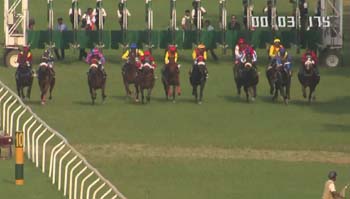
The critical question is what happened after the initial jump. Dreams Come True did not merely break outwards and straighten up. The horse continued to drift out, encroaching on Yinsiruk’s path and closing the space available to the filly. Yinsiruk was forced to check sharply and nearly clipped the heels of the horse in front. The following horse was also caught in the incident, with its jockey coming perilously close to being unbalanced and falling. The two horses made body contact.
The distinction is crucial. An initial outward movement might be an ordinary feature of the break, but continuing to drift into another runner’s path is a different matter. If a horse closes the road and leaves another with no reasonable opportunity to avoid a collision or severe check, the consequences cannot simply be blamed on the horse behind.
The three-quarter-length winning margin makes the incident all the more significant. Yinsiruk was carrying top weight, was forced to travel wide and, despite losing its rhythm at the start and travelling wide, recovered to finish strongly. Nobody can say with certainty that the filly would have beaten Dreams Come True without the interference. But it would be equally unreasonable to conclude that the incident had no material effect merely because she recovered to finish second.
A horse’s ability to overcome adversity should not become a reason to discount the disadvantage suffered. A severe check at the start can disrupt rhythm, cost momentum and compromise a horse’s position for the remainder of the race. The damage is not necessarily reflected in the final margin.
The objection was closely contested. All three stipendiary stewards and two stewards favoured overruling it, while two stewards supported upholding it. The chairman’s casting vote ultimately settled the matter in favour of the objection.
The difference of opinion is noteworthy. The collective view of the stipendiary stewards deserves consideration, but a majority opinion is not infallible. Each official must examine the sequence of events, identify the horse responsible and assess the consequences. In this case, distinguishing the initial jump from the winner’s subsequent outward drift was essential.
The fact that horses can jump sideways from the stalls is well understood by anyone familiar with racing. But the argument cannot end there. What matters is whether the horse straightened up or continued to encroach on another runner’s path. In my assessment, the video supports the latter interpretation.
Sandesh deserves credit for keeping his horse balanced and avoiding a potentially serious fall. But skilful horsemanship in a difficult situation does not settle the question of responsibility. Nor does the possibility that the horse behind contributed to the final contact absolve the horse whose movement initiated the chain of events.
The stewards’ task is not to punish a horse for an imperfect break. It is to determine whether interference occurred, who was responsible and whether it warranted reversal under the applicable rules. The severity of the check, Yinsiruk’s compromised running line and the narrow margin provided compelling grounds for upholding the objection.
In my view, the right decision was made. The objection should not be judged simply by the fact that Yinsiruk finished second, but by the disadvantage the filly had to overcome. A horse responsible for material interference should not retain the benefit of the result merely because its rival showed the ability to recover.
The incident also highlights the urgent need to bring racecourse video coverage up to international standards. High-definition cameras, multiple angles, high-frame-rate slow-motion replays and clear views of the start would allow stewards to establish the sequence of events with far greater precision. Technology cannot eliminate human judgment, but it can substantially reduce subjectivity, minimise avoidable differences in interpretation and make decisions more transparent. In contentious objections, the evidence should do most of the talking, leaving the stewards to interpret the facts rather than struggle to establish them. The clearer the footage, the smaller the scope for human error.
|
|